

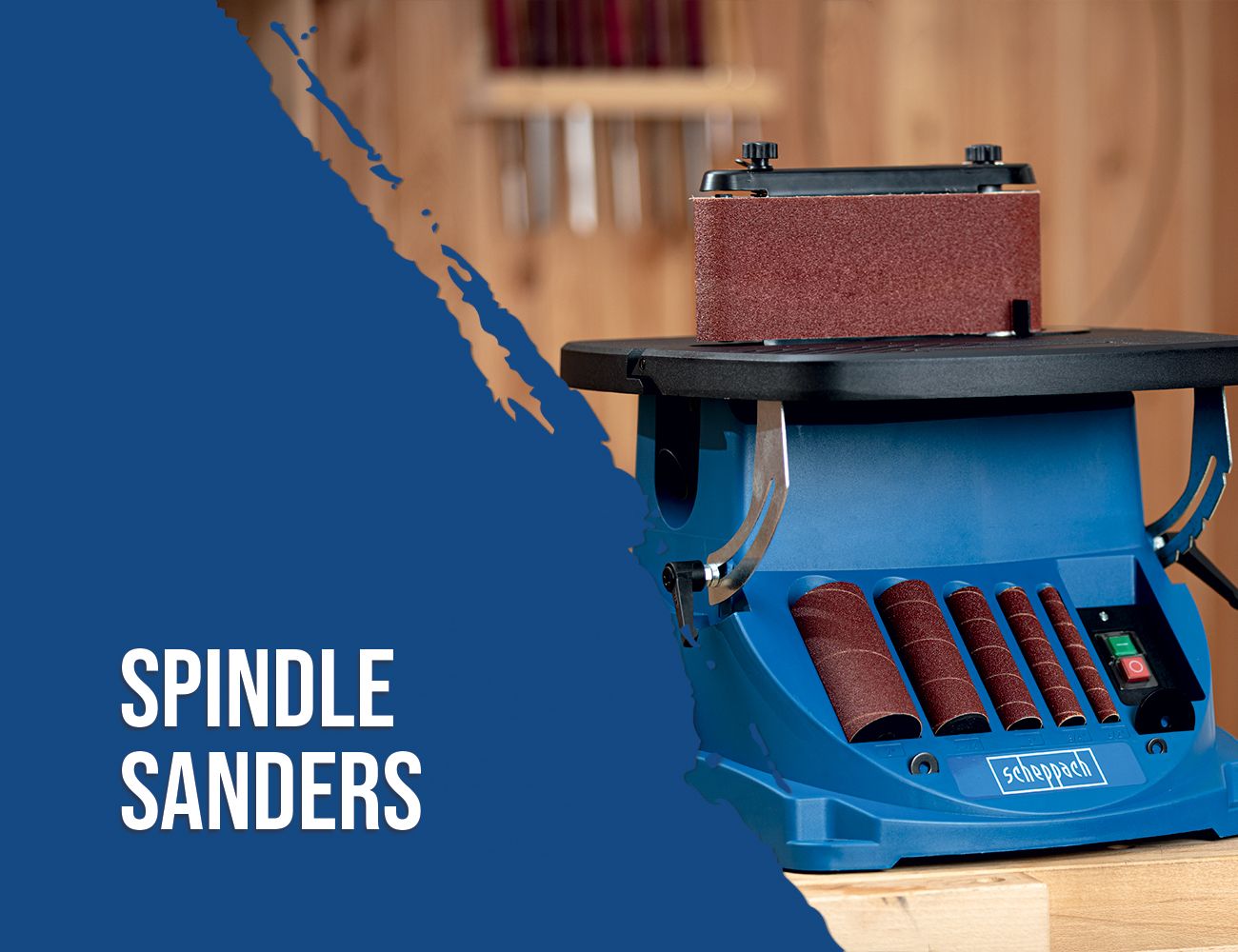
Spindle Sanders
Creating smooth curves, refined edges and accurately finished profiles is often one of the most challenging parts of woodworking. While hand sanding can be time-consuming and difficult to keep consistent, a spindle sander provides a faster, more precise solution for smoothing internal curves, cut-outs and shaped workpieces.
Scheppach's range of spindle sanders is designed to help DIY enthusiasts, home workshops and professional woodworkers achieve precise, repeatable results across a variety of woodworking projects. Developed using German engineering principles, these machines provide controlled sanding performance for curved components, furniture parts, templates and decorative joinery. Supported by UK after-sales service and genuine spare parts availability, Scheppach spindle sanders are designed to deliver dependable performance throughout years of workshop use.
This guide explains how spindle sanders work, their advantages and the key considerations when selecting the right model for your woodworking workshop.
Choosing the Right Spindle Sander
The right spindle sander depends on the type of woodworking projects you complete most often. If your work regularly involves curved edges, internal cut-outs or intricate profiles, a spindle sander offers greater precision and consistency than hand sanding alone.
For DIY users and hobbyists, a compact benchtop spindle sander provides an excellent way to achieve professional-looking results while occupying minimal workshop space. For users producing furniture, cabinetry or decorative timber components more frequently, a machine designed for regular use can improve efficiency while maintaining consistent sanding quality.
It is also worth considering the range of workpieces you'll be sanding. Spindle sanders are particularly useful for smoothing jigsaw cuts, refining routed components and preparing curved surfaces before painting, staining or varnishing.
Choosing a machine that suits both your project requirements and available workshop space helps deliver better results while making detailed sanding tasks quicker and more enjoyable.
Understanding Spindle Sanders
Unlike traditional belt or disc sanders, a spindle sander uses a vertically mounted sanding drum to smooth curved and irregular shapes.
As the sanding sleeve rotates, the spindle also oscillates up and down, distributing wear evenly across the abrasive. This oscillating action helps achieve a more uniform finish while reducing heat build-up and extending the working life of the sanding sleeve.
Different spindle diameters allow users to sand both tight internal curves and larger sweeping profiles, making spindle sanders suitable for a wide variety of woodworking applications.
Whether producing furniture, decorative panels, templates or bespoke joinery, spindle sanders provide accurate control while maintaining smooth, consistent finishes across complex shapes.
Choosing the Right Sanding Sleeve
Selecting the correct sanding sleeve is essential for achieving both efficient material removal and a high-quality surface finish.
Coarse grit sleeves are ideal for quickly removing material and refining rough-cut curves. Medium grits provide a balance between shaping and finishing, while finer grits prepare timber surfaces for painting, staining or clear finishes.
Using the correct spindle diameter also contributes to better results. Smaller sanding drums are ideal for tight curves and detailed work, while larger diameters help maintain smooth, flowing profiles on broader curved surfaces.
Replacing worn sanding sleeves when necessary helps maintain sanding performance while producing more consistent finishes throughout every project.
Producing Smooth Curves with Greater Accuracy
Accurate curved sanding relies on good technique as much as the machine itself.
Supporting the workpiece firmly and allowing the spindle to remove material steadily helps achieve smoother, more consistent results while reducing the risk of over-sanding. Working progressively through finer abrasive grits also improves surface quality before finishing.
Whether you're refining jigsaw cuts, shaping templates or completing bespoke furniture projects, a spindle sander provides excellent control and repeatable accuracy for detailed woodworking applications.
Scheppach Product Range
Scheppach's spindle sanders are designed to help woodworkers achieve smooth, high-quality finishes on curved workpieces, internal cut-outs and shaped components. Their oscillating sanding action provides greater control than hand sanding, making them ideal for projects that require precision and a consistent surface finish.
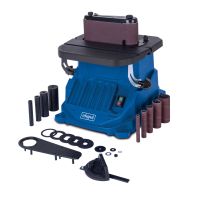
The OSM100 is a practical choice for DIY enthusiasts, hobbyists and home workshops looking to produce clean, smooth curves with minimal effort. It is well suited to refining jigsaw cuts, sanding decorative profiles and preparing timber components before painting, staining or varnishing. Its compact benchtop design makes it an excellent addition where workshop space is limited.
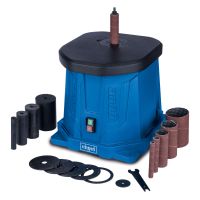
For users who regularly undertake furniture making, cabinetry or more demanding woodworking projects, the OSM600 offers dependable performance for sanding both tight curves and larger shaped workpieces. Its oscillating spindle action helps distribute abrasive wear evenly while producing a smoother finish, making it suitable for repetitive workshop use and projects that require consistent results.
Whether you're creating templates, shaping furniture components or refining intricate joinery, Scheppach spindle sanders provide reliable sanding performance. With genuine spare parts and dedicated UK after-sales support available, you can keep your equipment working efficiently as your workshop and projects continue to grow.
Accessories & Maintenance
Regular maintenance helps your spindle sander continue delivering smooth, accurate sanding performance.
Sanding sleeves should be checked regularly for wear and replaced when they no longer remove material efficiently. Fresh abrasives improve sanding performance, produce cleaner finishes and reduce unnecessary strain on both the machine and the workpiece.
Dust and sanding debris should be removed after every use, particularly from the table surface, ventilation openings and moving components. Keeping the machine clean helps maintain reliable operation while supporting effective cooling during longer sanding sessions.
The oscillating mechanism should be kept free from excessive dust build-up, while sanding drums and sleeves should always be securely fitted before use. Following the maintenance recommendations in the user manual helps ensure dependable long-term performance.
When replacement sleeves, drums or components are required, Scheppach genuine spare parts help maintain compatibility and reliable operation throughout the life of your machine.
Frequently Asked Questions
What is a spindle sander used for?
A spindle sander is used for sanding curved edges, internal cut-outs and shaped timber components. It is particularly useful for refining jigsaw cuts, furniture parts, templates and decorative woodworking projects where smooth, accurate curves are required.
What is the advantage of an oscillating spindle sander?
An oscillating spindle sander moves the sanding drum both rotationally and vertically. This helps distribute abrasive wear more evenly, reduces heat build-up and produces a smoother, more consistent finish than a non-oscillating spindle.
Can a spindle sander be used on straight edges?
Although it is designed primarily for curved work, a spindle sander can also refine shorter straight sections and detailed profiles. For larger flat surfaces and long straight edges, a belt and disc sander is generally the more suitable option.
How often should sanding sleeves be replaced?
Sanding sleeves should be replaced whenever they become worn or stop removing material effectively. Using fresh abrasives helps maintain efficient sanding performance and improves the quality of the finished workpiece.
How do I maintain a spindle sander?
Routine maintenance includes cleaning away dust after each use, inspecting sanding sleeves for wear, ensuring sanding drums remain securely fitted and following the servicing guidance provided in the user manual. Regular maintenance helps ensure reliable performance and extends the life of the machine.
Making the Right Choice
A spindle sander is an excellent addition to any woodworking workshop where curved components, internal cut-outs and detailed profiles are regularly produced. Choosing the right machine depends on the size of your projects, the frequency of use and the level of precision required.
Whether you choose the OSM100 or OSM600, Scheppach spindle sanders are designed to provide smooth, accurate sanding performance across a wide range of woodworking applications. Supported by genuine spare parts and dedicated UK after-sales service, they offer dependable performance to help you achieve professional-quality results with confidence.